05 / 06
Electrochemical surface modification
Molecular layers grafted and grown on electrodes.
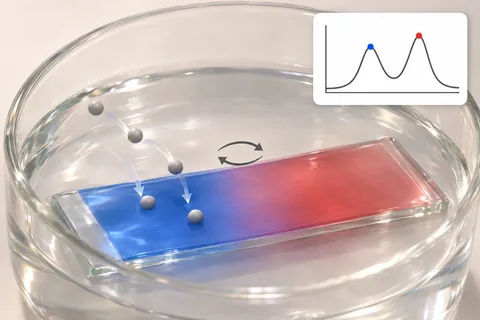
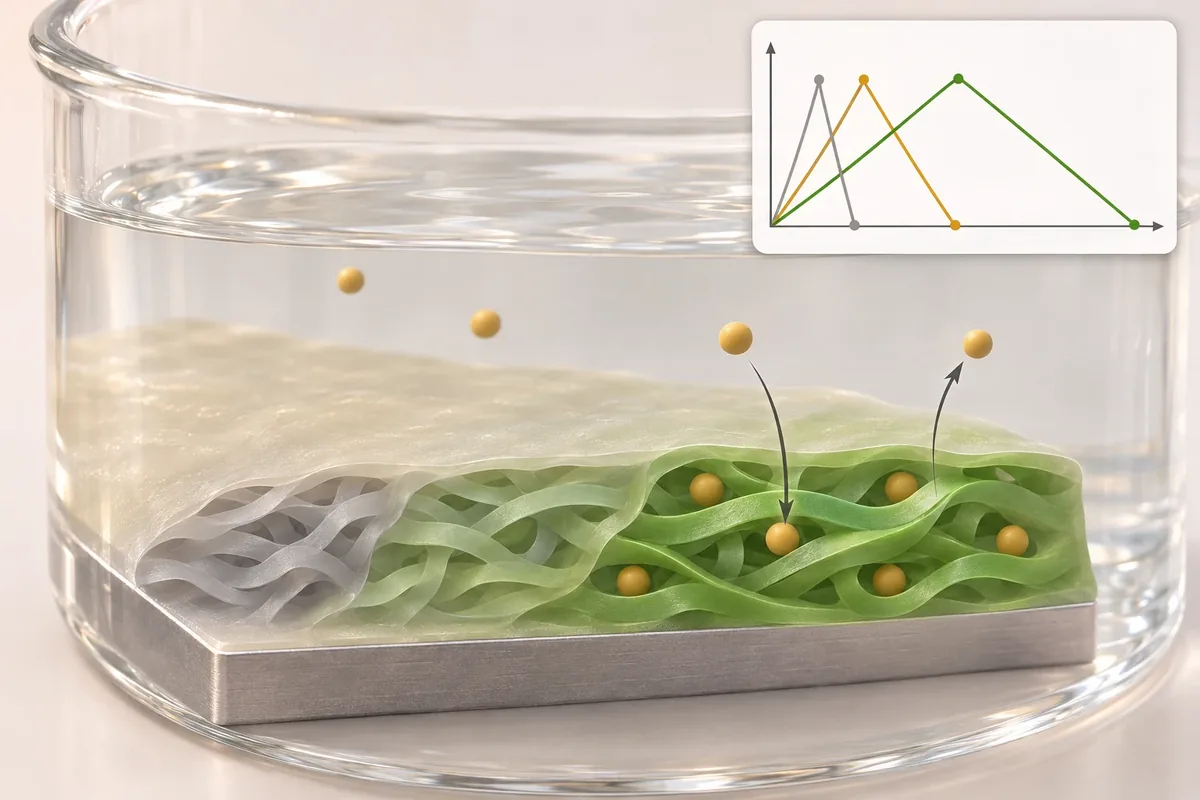
Which molecules sit on an electrode, and how many, decides how it transfers electrons, what it senses and how long it lasts. We build these layers by grafting aryldiazonium and by growing polymers directly on the electrode, and control how thick and how dense they become.
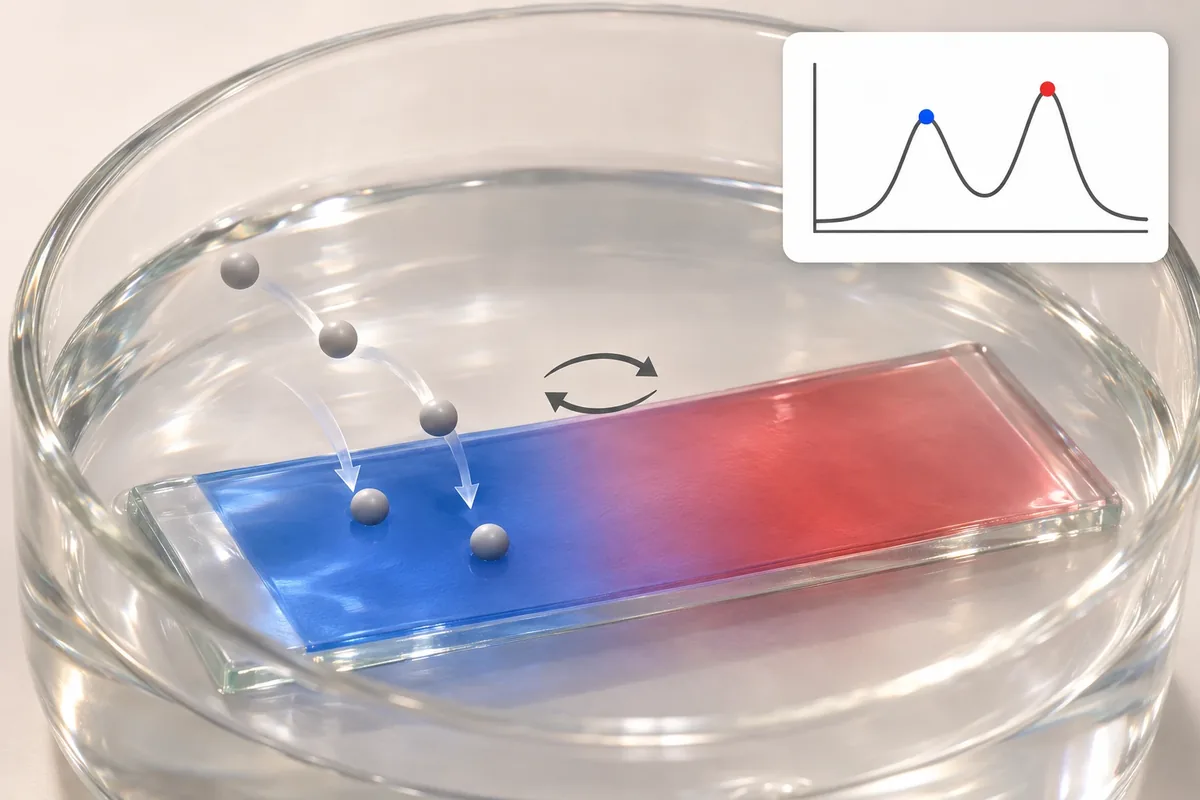
- Tunable electrografting of aryldiazonium: controlling the thickness and density of covalently bound layers, and choosing the next grafting condition with Bayesian optimization.
- Electropolymerization: conducting and redox polymers grown directly on the electrode, for supercapacitors and electrochromic films.
- Thiazole-based polymers: thiazole monomers bearing thiophene or selenophene, grown into films whose structure sets how much charge they store and how their color changes.
- Layers that hold things: grafted films as anchors for DNA probes, redox polymers and enzymes in sensors.
Try it
Cover the surface simplified
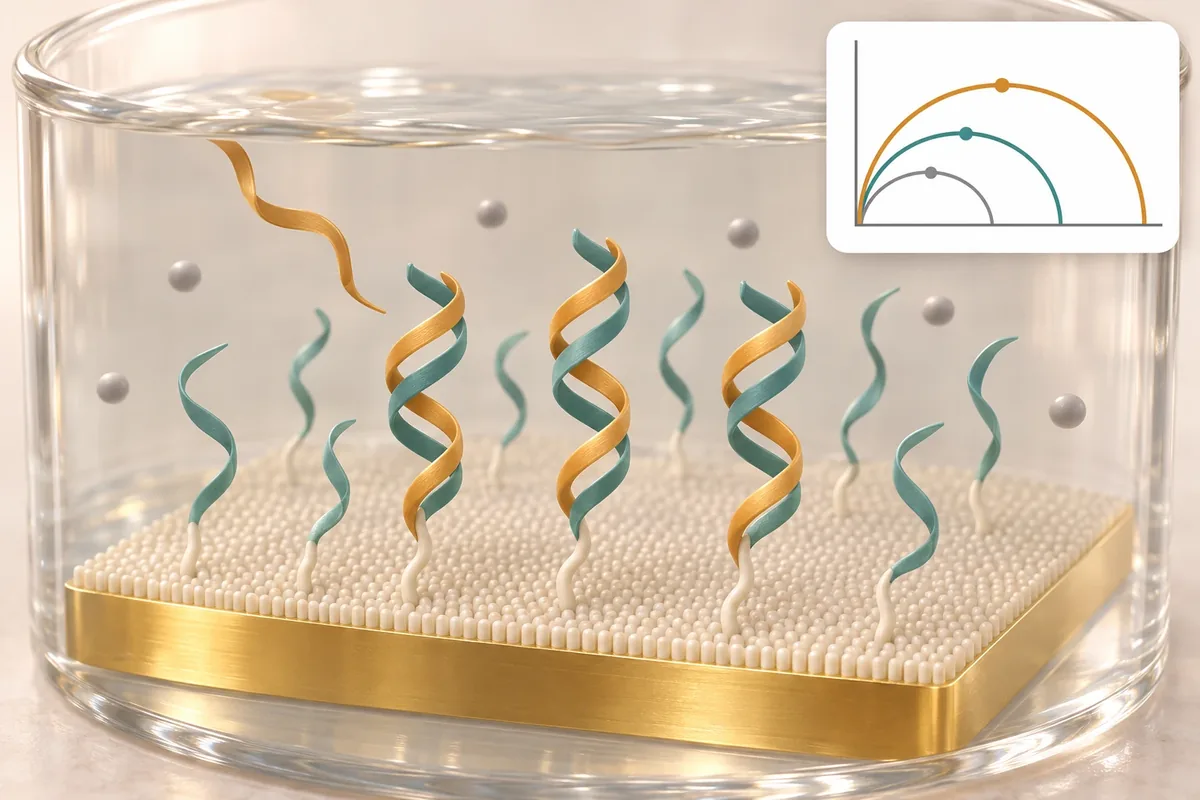
As a grafted layer blocks more of the electrode, the charge-transfer semicircle in the impedance plot grows. Simplified Randles circuit.
θ = 0.30, Rct ≈ 286 Ω
Rct = Rct⁰ / (1 − θ) with Rct⁰ = 200 Ω, Rs = 50 Ω, Cdl = 10 µF held fixed as θ changes, no diffusion element. At θ = 0.3, Rct ≈ 286 Ω.
Selected papers
 Hong, S.; Yoon, J. H.; Jeong, S.; Kim, Y.-R.*; Kim, I. T.* Electropolymerization of thiazole derivative bearing thiophene and selenophene and the potential application in capacitors. J. Electroanal. Chem. 2022, 916, 116386. DOI: 10.1016/j.jelechem.2022.116386
 Kang, S. J.; Kim, S.; Lee, K.; Shin, I.-S.; Kim, Y.-R.* Tunable electrochemical grafting of diazonium for highly sensitive impedimetric DNA sensor. J. Electrochem. Soc. 2020, 167, 087504. DOI: 10.1149/1945-7111/ab8ce8
 Choi, K.-S.; Han, J. W.; Kim, M. H.; Yoon, M.; Kim, Y.-R.*; Kim, I. T.* Electropolymerization of thiazole derivative bearing thiophene and its application in capacitors and electrochromic devices. J. Electroanal. Chem. 2019, 848, 113329. DOI: 10.1016/j.jelechem.2019.113329
Other themes
- 01Ion-selective electrodesElectrodes that pick one ion out of many, used to read nutrients in soil and hydroponic solutions.
- 02Nanoelectrochemistry and imagingReactions measured and mapped at the nanoscale with nanoelectrodes, scanning probes and nanopipettes, and features written with them.
- 03Mediated enzyme electrodesMediators that carry electrons from enzymes to electrodes, designed in the lab for glucose strips and microneedles.
- 04Electrodeposition and patterningFilms and patterns grown by current, cathodic or anodic, from the first nuclei to patterned electrodes.
- 06Molecular electrochemistryHow molecules gain and lose electrons, seen through current and light: mechanisms, proton-coupled electron transfer and spectroelectrochemistry.
Join us
Graduate school
MS, PhD and integrated MS–PhD. Email Prof. Yang-Rae Kim with a short note on your background and the theme that interests you. Applications go through the Kwangwoon University Graduate School (grad.kw.ac.kr).
Subject: Graduate study
Undergraduate research
Tell us your major, year and interests. You start by making electrodes and measuring with them yourself.
Subject: Undergraduate research
International applicants: no degree positions at present. Researchers who want to collaborate are welcome: see Contact and Equipment.