03 / 06
Mediated enzyme electrodes
Mediators that carry electrons from enzymes to electrodes.
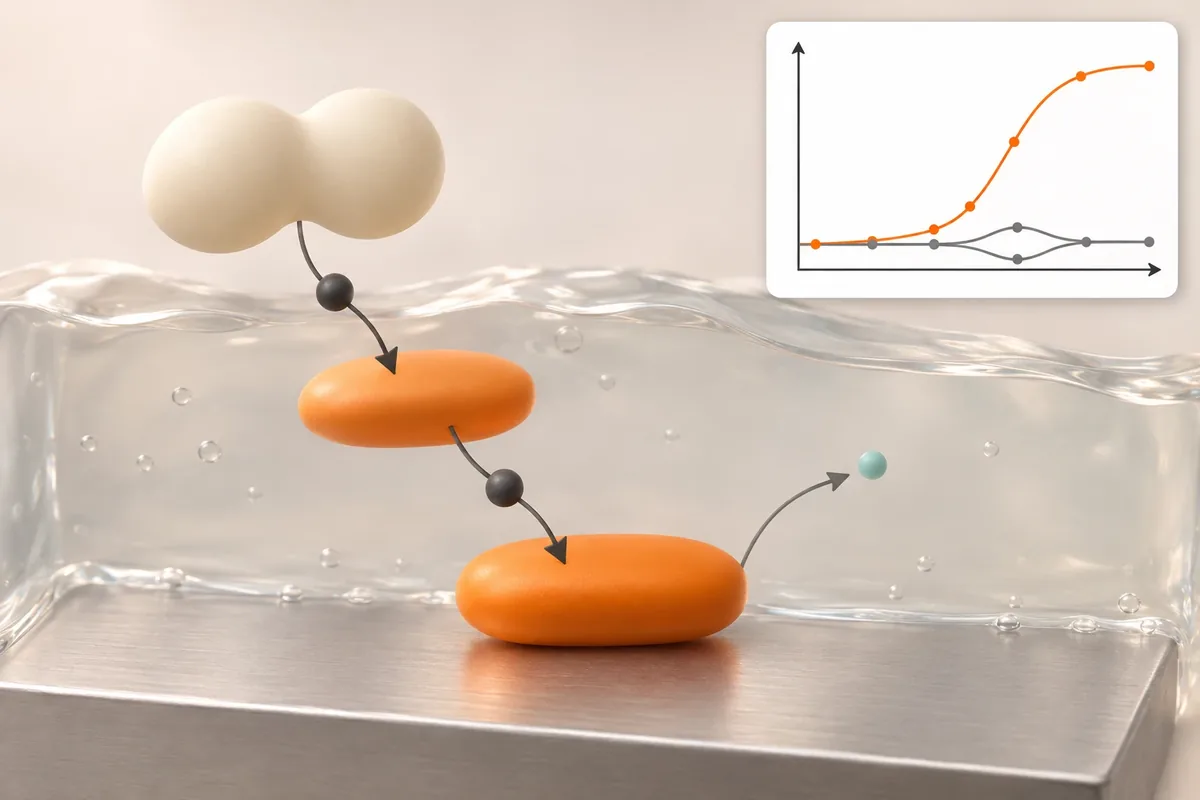
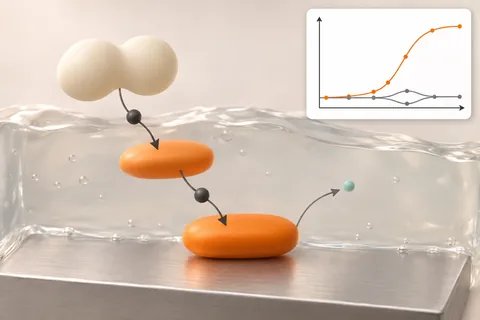
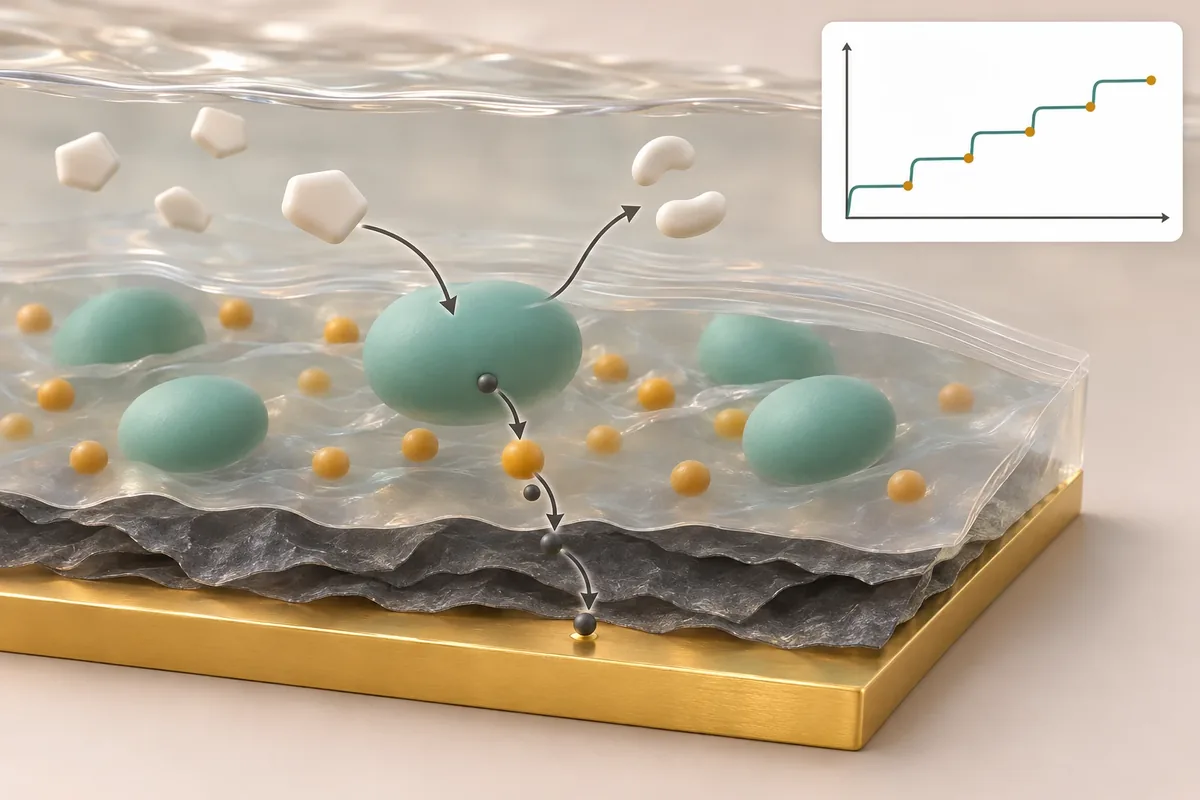
Our enzyme electrodes work by relay. In our glucose sensors, an enzyme takes electrons from glucose and hands them to its cofactor (NAD⁺ becomes NADH), a small redox molecule called a mediator carries them from NADH to the electrode, and the current tells how much glucose is there. We design the mediator and the electrode around it.
Mediators made in the lab
We synthesize new redox mediators and measure their thermodynamics. Our phenothiazine derivatives carry electrons from NADH to the electrode at a low potential, where common interferents react much less. We pair them with nicotinamide adenine dinucleotide (NAD)-dependent glucose dehydrogenase, an enzyme that does not need oxygen, so the reading does not depend on dissolved oxygen.
From strips to continuous monitoring
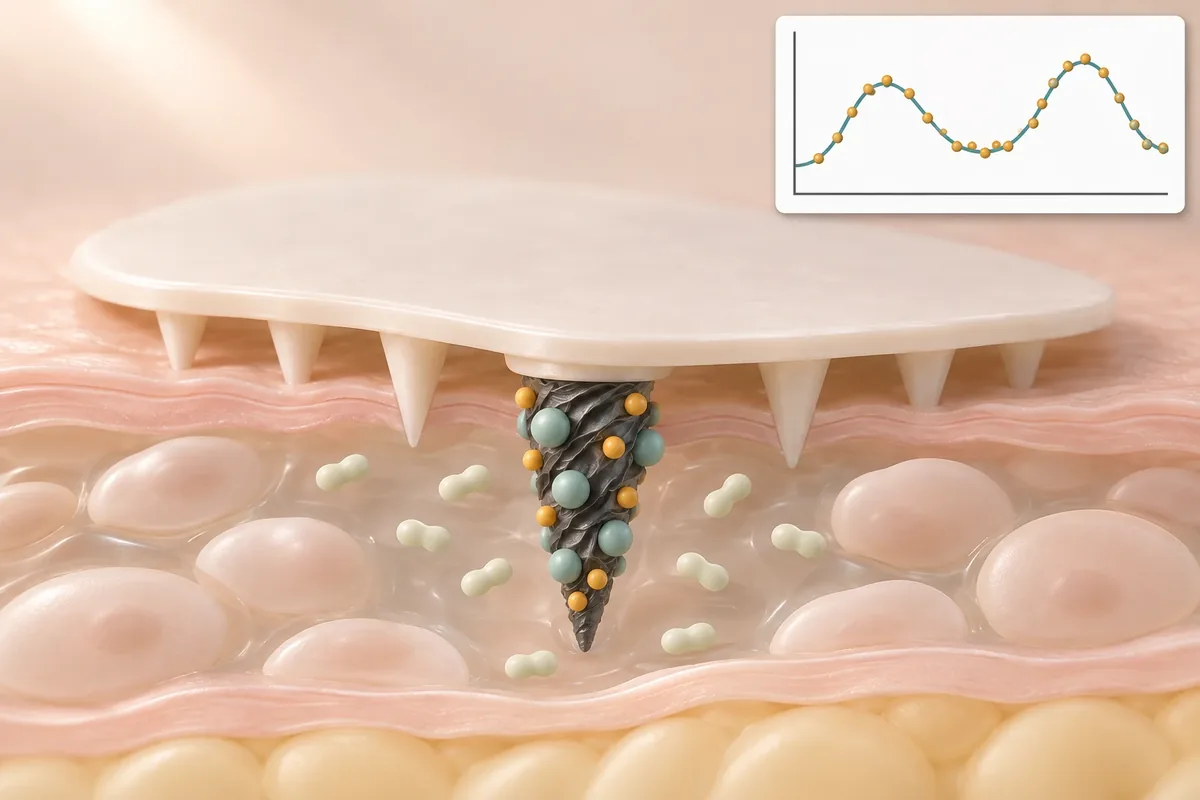
On planar electrodes, enzyme, cofactor and mediator sit in one layer on reduced graphene oxide and have been tested in human serum, the format of a disposable strip. On polymer microneedles, the same chemistry reads glucose through the skin, continuously.
Beyond glucose
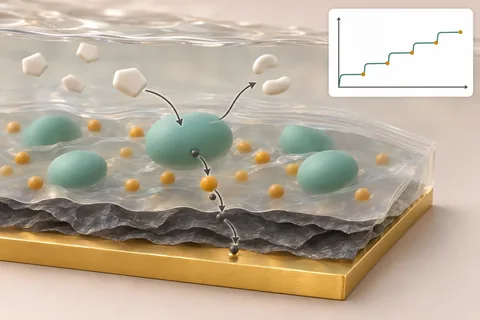
Electrochemical nucleic acid (DNA) sensors on diazonium-modified gold electrodes. (Diazonium grafting: → Electrochemical surface modification)
Selected papers
 Yoo, J.; Kim, I. T.*; Park, J. Y.*; Kim, Y.-R.* Electrochemical glucose sensor based on a phenothiazine derivative mediator with nicotinamide adenine dinucleotide-dependent glucose dehydrogenase. Sens. Actuators, B 2025, 422, 136630. DOI: 10.1016/j.snb.2024.136630
 Park, S.†; Hong, S.†; Kim, S.; Choi, J. H.; Kang, S. J.; Choi, J.; Chung, Y.; Nam, H.*; Kim, Y.-R.* Electrochemical characterization and performance of phenothiazine derivatives as redox mediators. Electrochim. Acta 2023, 458, 142539. DOI: 10.1016/j.electacta.2023.142539
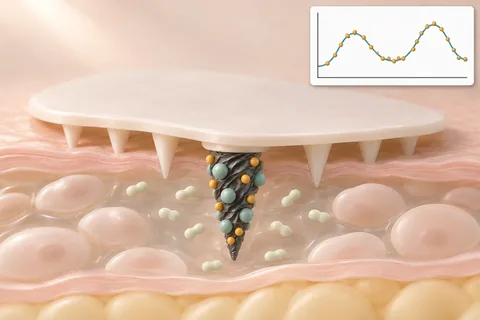 Sharifuzzaman, M.†; Shin, Y. D.†; Yoo, J.†; Reza, M. S.; Kim, Y.-R.*; Park, J. Y.* An oxygen-insensitive and minimally invasive polymeric microneedle sensor for continuous and wide-range transdermal glucose monitoring. Talanta 2023, 263, 124747. DOI: 10.1016/j.talanta.2023.124747
Other themes
- 01Ion-selective electrodesElectrodes that pick one ion out of many, used to read nutrients in soil and hydroponic solutions.
- 02Nanoelectrochemistry and imagingReactions measured and mapped at the nanoscale with nanoelectrodes, scanning probes and nanopipettes, and features written with them.
- 04Electrodeposition and patterningFilms and patterns grown by current, cathodic or anodic, from the first nuclei to patterned electrodes.
- 05Electrochemical surface modificationMolecular layers grafted and grown on electrodes: aryldiazonium layers and electropolymerized films.
- 06Molecular electrochemistryHow molecules gain and lose electrons, seen through current and light: mechanisms, proton-coupled electron transfer and spectroelectrochemistry.
Join us
Graduate school
MS, PhD and integrated MS–PhD. Email Prof. Yang-Rae Kim with a short note on your background and the theme that interests you. Applications go through the Kwangwoon University Graduate School (grad.kw.ac.kr).
Subject: Graduate study
Undergraduate research
Tell us your major, year and interests. You start by making electrodes and measuring with them yourself.
Subject: Undergraduate research
International applicants: no degree positions at present. Researchers who want to collaborate are welcome: see Contact and Equipment.